
Fridley Directory Collections
The strongest verified Fridley historical-directory source is actually the Minnesota Historical Society’s Anoka County telephone-directory collection. Its finding aid describes a large research collection of print volumes and microfiche, with Fridley entries beginning in 1953. These telephone books are useful historical directories because the white pages can join a listed name, phone number, and street address. They are not proof of ownership, continuous occupancy, or every person at an address. The finding aid, rather than an assumed publisher run, is the sound starting point for choosing a year.
| Collection | Years | Where Held | Access |
|---|---|---|---|
| MNHS Anoka County telephone directories, Fridley entries | 1953, then selected 1957-2005 holdings | Minnesota Historical Society | Open for research; confirm print or fiche identifiers first |
| Fridley telephone full and Yellow Pages volumes | 1971-1980 full and Yellow Pages; later years vary | Minnesota Historical Society | Use the finding aid’s year-by-year entries |
| Anoka County History Center census and local-history materials | Census 1857-1920; maps and newspapers span other eras | Anoka County History Center | Research collection; appointment access during relocation |
| Life weekly newspaper microfilm | 1973 through March 2009 | Johnsville Library and Mississippi Library in Fridley | In-library microfilm; copies are not holdable |
Several important gaps should remain visible in a research note. No official Fridley-specific Polk or Haines run, complete reverse directory, or scanned residential city-directory run was located. The MNHS material is a verified telephone-directory collection, not a substitute name for an unconfirmed Polk directory. A missing year in the holding describes the shelf, not necessarily the absence of a local listing.
Fridley Telephone Directory Years
The MNHS finding aid for Anoka County telephone directories is the source to consult before selecting a Fridley telephone-directory year. It lists 1953 and 1957 through 1960 in the early run, then describes the 1960s in detail. Full and Yellow Pages volumes appear for every year from 1971 through 1980. The later pattern changes again: 1981 is Yellow Pages only, 1982 through 1987 have full and Yellow Pages material, 1988 is Yellow Pages only, and 1989 through 1992 return to both forms. The documented run then resumes with selected 1999 through 2005 material.
The MNHS directory finding aid shows the documented Fridley telephone holdings in their collection context.
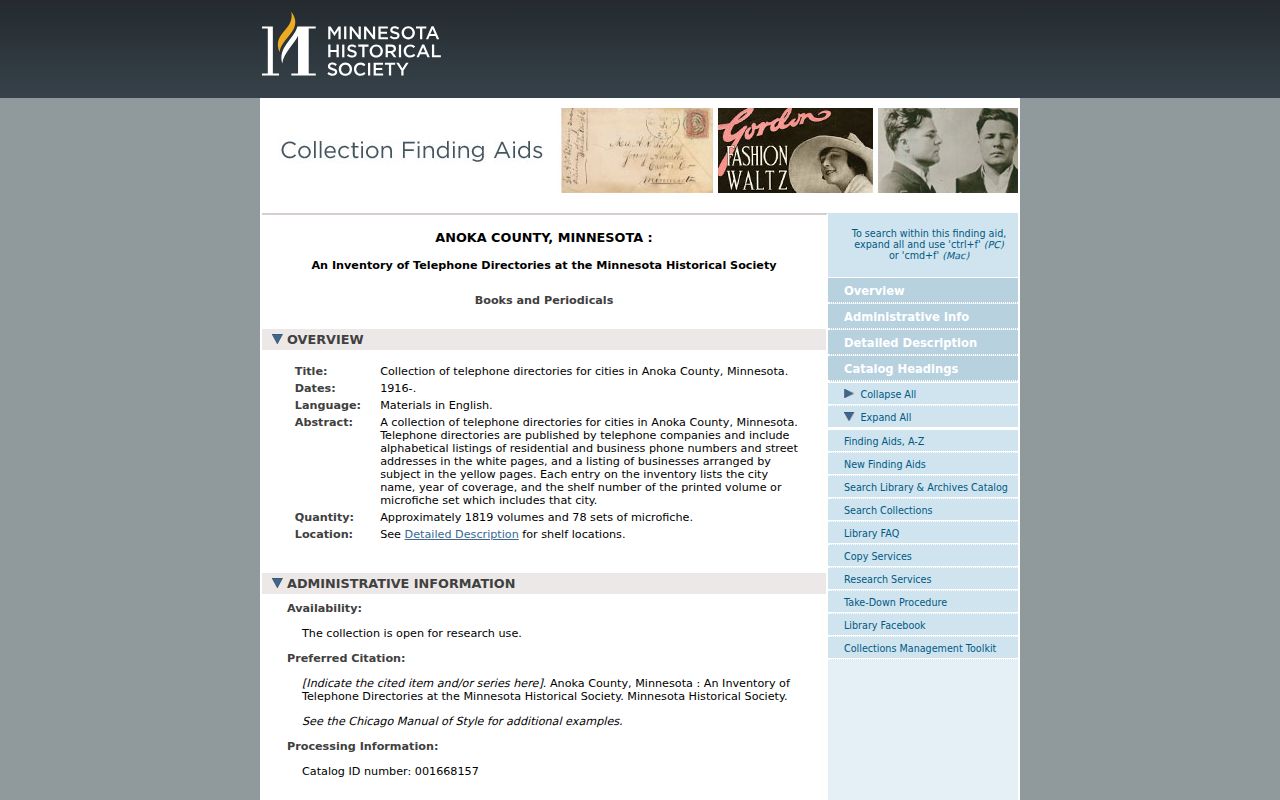
Use the captured listing to identify a likely year, then verify whether that year is a full book, a Yellow Pages volume, print, or microfiche before relying on it for a household trail.
Note: The collection’s format label is part of the evidence because full telephone books and Yellow Pages volumes serve different research purposes.
Fridley Telephone Books and Yellow Pages
Full books and Yellow Pages answer different questions. The finding aid describes white pages as alphabetical residential and business telephone listings with street addresses. Yellow Pages are organized by subject. A Yellow Pages-only year can help identify an advertised service or business category, but it does not establish that the white pages were searched or that a household had no listing. Preserve the format beside each citation, especially for 1981 and 1988.
| 1953-1960 | Early print holdings include 1953 and selected late-1950s years; 1960 also has Yellow Pages. |
|---|---|
| 1971-1980 | The documented Fridley run has both full and Yellow Pages volumes each year. |
| 1981 and 1988 | Yellow Pages-only holdings in the finding aid, not proof that no white-page listing existed elsewhere. |
| 1999-2005 | Selected fiche and print holdings, including 2000 print and print/Yellow Pages material for 2001-2005. |
Record an absence as “not found in the consulted holding,” not as a confirmed move or death. That wording leaves room for an unlisted number, a spelling variant, a different book format, or a gap in the collection.
Note: The detailed finding aid, rather than a simplified date range, controls whether a particular Fridley telephone volume is available.
Fridley Directory Research at ACHS
The Anoka County History Center research collection supplies the companion evidence that a telephone listing lacks. Its holdings include newspapers, obituary indexes, burial information, maps, census material, church and civil records, photographs, oral histories, and subject files. The center also points house-history requests toward an address or parcel first, then toward deeds, directories, newspapers, and owners. That sequence keeps a single directory hit from carrying more weight than it can support.
The History Center relocation notice documents the local research setting and the current access change.
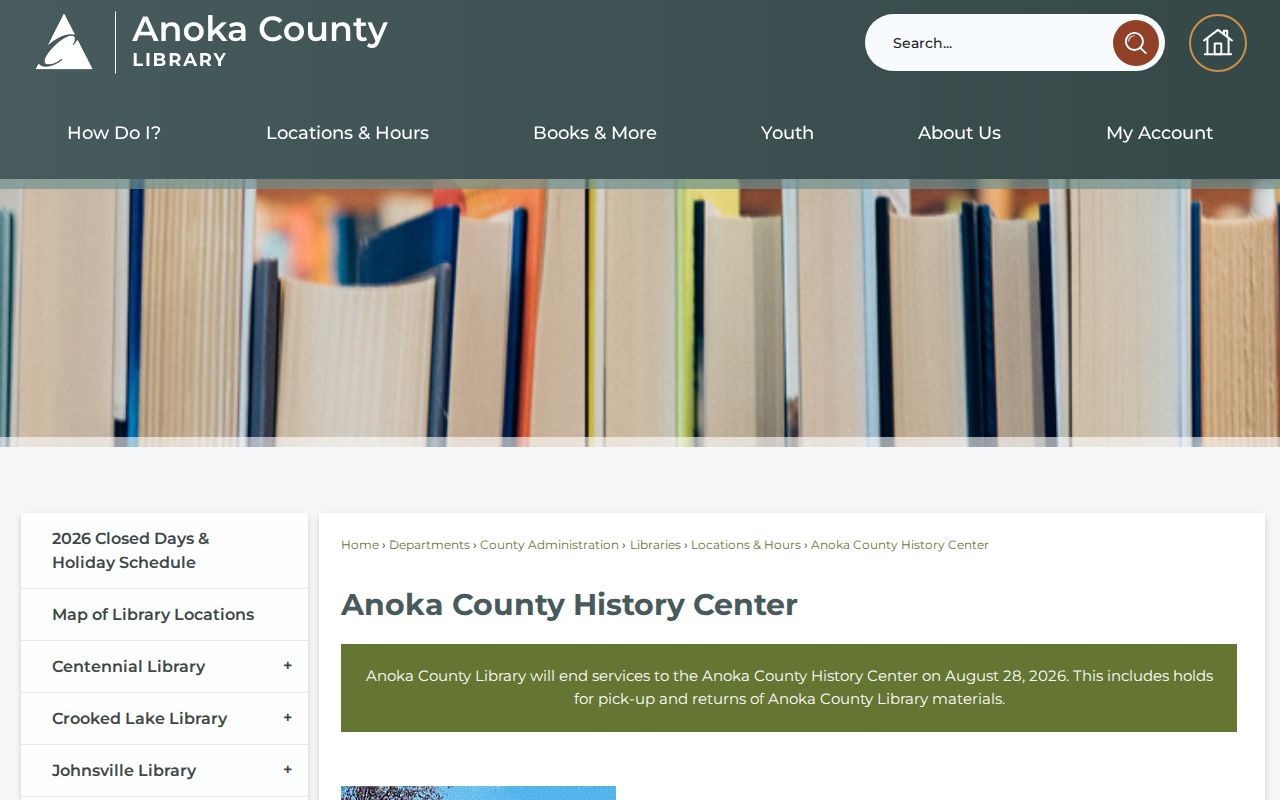
Library services at the center end August 28, 2026 because of relocation, and the historical society’s FAQ says summer 2026 visits are by appointment. Call 763-421-0600 before travel, even when a regular-hours listing appears elsewhere.
Reading a Fridley Telephone Entry
A Fridley telephone entry in the verified collection should be read narrowly. An alphabetical white-page listing can supply a listed name, phone number, and street address in the volume’s year. It may include a business listing as well. The official collection description does not promise spouse names, occupations, ownership marks, or a full householder sequence, so those details should not be supplied from habit. A 1966-67 University of Minnesota directory scan does demonstrate a different institutional format with name, role, office contact, home address, and home phone, but it is not a general Fridley directory.
| Listed name | Identifies the name printed in the alphabetical telephone listing for that year. |
|---|---|
| Telephone number | Connects the listing to a number at the time of publication, subject to listing and publication limits. |
| Street address | Places the listed telephone contact at an address, not necessarily as owner or continuous occupant. |
| Format | Distinguishes a full telephone book from a subject-arranged Yellow Pages volume. |
| Institutional fields | May appear in a separate institutional directory, but do not convert those fields into citywide coverage. |
- Criss-cross or reverse directory
- A directory arranged by street or address rather than alphabetically by name. No confirmed Fridley-specific reverse run was located, so do not assume one exists in every MNHS year.
- Householder index
- An index that can group people by household when a publisher provides it. The MNHS finding aid does not confirm such an index for the Fridley telephone run.
- Abbreviation key
- A publisher’s explanation of short forms when it is printed in a volume. The inspected description does not document a Fridley key, so save it only if the consulted book contains one.
Note: A source note should distinguish a documented telephone field from a detail that merely appears in some other type of directory.
Fridley Directory Census Bridges
When telephone years skip across a family’s move, census and map material can bridge the interval. ACHS holds or indexes census material from 1857 through 1920, while Minnesota territorial and state census years include 1857, 1875, 1885, 1895, and 1905. Federal census releases extend through 1950. These sources place a household in a dated enumeration, but the address form may differ from a modern street address. Match people, place, and time before assigning an old census entry to a present parcel.
For a newspaper layer, the Life: Blaine, Spring Lake Park, Columbia Heights, Fridley catalog record documents microfilm from 1973 through March 2009 at Johnsville and Mississippi libraries. Notices, obituaries, community items, and announcements may explain an address change or name variation. They are useful corroboration, not a full telephone directory.
Fridley Directory Maps and Addresses
Old addresses can require a map before a name search makes sense. The History Center identifies land plat maps for 1888, 1914, and 1932, as well as city and county maps from the 1850s forward. They can show whether a street existed under a different layout, whether a lot began as part of a larger tract, or whether subdivision changed the parcel context. Pair them with the Anoka GIS plat and historical-aerial links, then rely on a recorded legal description rather than treating an old map as a present boundary survey.
Fridley’s record history also crosses township, village, and city terms. The area became a village in 1949 and a home-rule charter city in 1957. Keeping the original place description beside a modern address preserves the trail instead of silently rewriting it.
Note: A map can explain an address change, but the recorded legal description remains the safer identifier for linking parcels across time.
Tracing a Fridley Directory Household
Trace a household through the shelf in deliberate jumps, then fill the spaces with independent records. A listed phone and address can lead to a newspaper notice, census household, or deed. It cannot by itself show title or establish that everyone at the address was listed. The historical collections are the focus here; when the question shifts to an address’s later ownership trail, the Fridley previous residents record path uses the deed chain rather than repeating the collection inventory.
- Start with the exact street spelling, number, and any surname variant from a parcel card, family paper, or prior record.
- Choose the nearest documented MNHS telephone year and note whether it is full, Yellow Pages, print, or fiche.
- Search the alphabetical white pages when available, recording the name, phone, address, year, and collection format together.
- Repeat in five- or ten-year jumps, treating an absence separately from a move or an unlisted number.
- Pair a directory lead with ACHS census, a map, a newspaper notice, a deed, or an official vital-record route before reaching a conclusion.
FamilySearch’s Minnesota county-marriage collection can add an indexed life-event lead for Anoka County, though sign-in, affiliate-center, or image restrictions may apply. Directory work becomes stronger when each result says exactly what record was consulted and what it actually proves.
Fridley Directory Limits
Fridley has no single official resident index, complete city-directory scan, municipal cemetery lookup, or confirmed full Polk or Haines set in the researched sources. A telephone listing is historical evidence of a listed contact, not permission to compile a personal profile. Use specific, lawful family-history, estate, property-history, or civic questions. Keep protected addresses and sensitive details out of a research summary, and let the relevant custodian correct an error.